


Syllabus: GS3/ Science & Technology
Context
- PM Modi flagged off India’s first Hydrogen powered train running between an 89-km stretch of Jind and Sonipat in Haryana, under the jurisdiction of Northern Railway’s Delhi Division.
India’s First Hydrogen-Powered Train
- Key Features of the train:
- The train was developed by Chennai-based Integral Coach Factory (ICF).
- It is a 10-car hydrogen fuel cell-based train set, powered by a 1200 kW hydrogen fuel cell propulsion system.
- The train consists of two Hydrogen Driving Power Cars (DPCs) and eight Trailer Coaches (TCs).
- Approved to operate at a maximum speed of 75 kmph with a design speed of 110 kmph.
Major Components of the Train
- Proton Exchange Membrane (PEM) Fuel Cells that generate electricity.
- Lithium Iron Phosphate (LFP) batteries that store surplus electricity and provide additional power during acceleration.
- High-pressure hydrogen storage cylinders for storing compressed hydrogen gas.
- Electric traction motors that convert electrical energy into mechanical motion.
- Safety Measures:
- Hydrogen leak detectors have been installed at the production, storage and dispensing facilities.
- Flame detectors have also been installed for continuous monitoring.
How Does the Hydrogen Train Work?
- A hydrogen-powered train is a fuel-cell electric train that generates electricity onboard using hydrogen gas instead of diesel fuel or electricity supplied through overhead transmission lines.
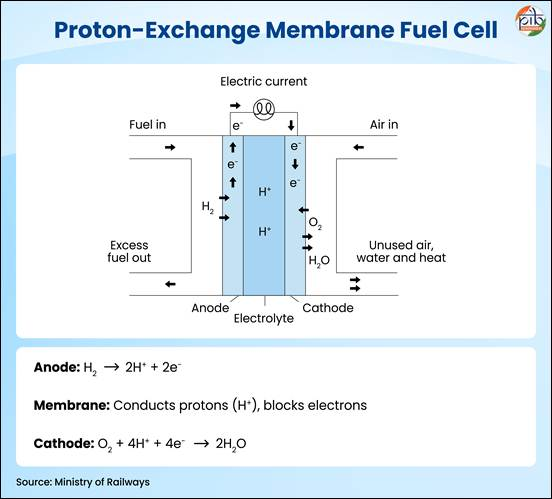
- Hydrogen fuel cell technology produces electricity through a chemical reaction using hydrogen.
- The primary energy source is a Proton Exchange Membrane Fuel Cell (PEMFC).
- The fuel cell generates electricity by reacting hydrogen and oxygen across a proton-conducting Perfluorosulfonic Acid (PFSA) polymer membrane.
- The process produces only water vapour and heat as byproducts.
- Electricity powers the traction motors that drive the train.
Significance
- Sustainable mobility: The project is a big step towards decarbonising the transport sector of India through the replacement of diesel traction with a technology with zero tailpipe emission.
- It provides a clean alternative for non-electrified routes.
- India’s climate commitments: It contributes to India’s promise of reaching Net Zero emissions by 2070.
- India’s technological leadership: India is now among the front-runners in the development of hydrogen-based railway transportation with the successful commissioning of one of the world’s most powerful hydrogen trainsets.
What are the Challenges?
- Hydrogen infrastructure: India has insufficient facilities for hydrogen generation, storage, transportation and refuelling, which restricts large scale adoption.
- High capital investment: Large capital outlay is required to set up hydrogen production plants, refuelling stations, fuel-cell systems and unique rolling stock.
- Safety concerns: Hydrogen is very flammable, requiring special storage facilities and strict operational safety procedures.
What is hydrogen?
- Hydrogen is a chemical element with chemical symbol H and atomic number 1.
- Hydrogen is the lightest of all elements and the most common chemical material in the universe, accounting for around 75% of all normal matter.
- It is a non-toxic, colourless, odourless, tasteless and extremely inflammable gas.
Previous article
SC’s Proposed Regulations for AI Use in Courts
Next article
News In Short 17-07-2026
